

Valuation for lower middle market businesses, those with annual sales between $5-$50 million, centers on applying a multiple to adjusted EBITDA, factoring in growth potential, risk, and industry trends. CII Advisors, based in Orlando and serving Florida owners for over four decades, identifies company-specific drivers that most directly influence final value.
Valuation for a Florida lower middle market business centers on EBITDA multiples adjusted for growth, risk, and industry trends. Company-specific factors, customer concentration, management depth, recurring revenue, drive value more than market conditions alone. CII Advisors uses competitive, auction-style buyer processes and a database of over 4,000 private equity groups and strategic acquirers to establish accurate, defensible valuations before a sale, including engagements with some of Florida’s largest landscaping companies.
Key Takeaways
- EBITDA multiples form the foundation for valuing lower middle market businesses in the $5-$50 million range.
- Market expectations of growth and risk directly adjust your company’s earnings multiple and final valuation.
- Strategic selling approaches for middle market businesses maximize value better than standard small business sale methods.
- CII Advisors’ four decades of experience guide Florida and Georgia business owners through complex valuations.
Why Does Valuation Matter Before You Sell?
Valuation sits at the heart of every middle-market transaction, shaping deal terms long before a buyer ever appears. For Florida business owners weighing a sale in the next one to three years, that number sets the tone for negotiations, financing, and even which buyers show interest. Skip this step, and an owner risks leaving real money on the table or scaring off qualified buyers with unrealistic expectations.
A clear lower middle market business valuation Florida owners can trust does more than satisfy curiosity. It becomes the foundation for every decision that follows: pricing, structuring, and timing the sale. Without it, owners negotiate blind, often accepting the first offer that sounds reasonable rather than one grounded in actual company performance.
Why Do Lower Middle Market Owners Need a Formal Valuation?
Owners of companies generating $5 million to $50 million in annual sales face a different buyer pool than smaller Main Street businesses. Private equity groups, strategic acquirers, and family offices evaluate these companies with sophisticated financial models, not gut instinct. A credible valuation levels that playing field.
What Happens If an Owner Skips Valuation Before Selling?
Skipping this step invites costly guesswork. Owners risk pricing a company too high and scaring off serious buyers. Too low and losing years of built equity in a single signature. Neither outcome serves the owner’s long-term financial goals.
CII Advisors helps Florida business owners navigate the valuation process and provides guidance on sales and mergers. The firm focuses specifically on lower middle market companies in the $5 million to $50 million revenue range, a segment that demands specialized knowledge of florida ma advisory ebitda multiples and deal structures. For owners considering an exit, understanding valuation early isn’t optional. It’s the difference between selling on their own terms or someone else’s.
What Counts As Lower Middle Market In Florida?
Annual sales between $5 million and $50 million place a Florida business squarely in the lower middle market business valuation Florida category. That revenue band covers a wide stretch of the state’s economy, from HVAC contractors in Tampa to manufacturing operations outside Jacksonville. Owners in this range face a different set of questions than a small retail shop or a local service business. The buyers, the paperwork, and the stakes all look different once revenue reaches this tier.
Why Does Company Size Change Who Shows Up To Buy?
Size changes everything about the buyer pool. Lower middle market and middle market companies typically carry more employees, more developed operations, and stronger revenue than smaller businesses. That scale attracts a more sophisticated class of buyer. Private equity groups, strategic acquirers, and well-capitalized investor groups study these deals closely. They expect thorough financials, clean records, and realistic valuation expectations before a conversation goes far.
That sophistication cuts both ways. Owners who understand how to value a business in Florida before entering talks hold a stronger negotiating position. Those who do not often leave money on the table, simply because they did not know what a buyer in this tier expects to see.
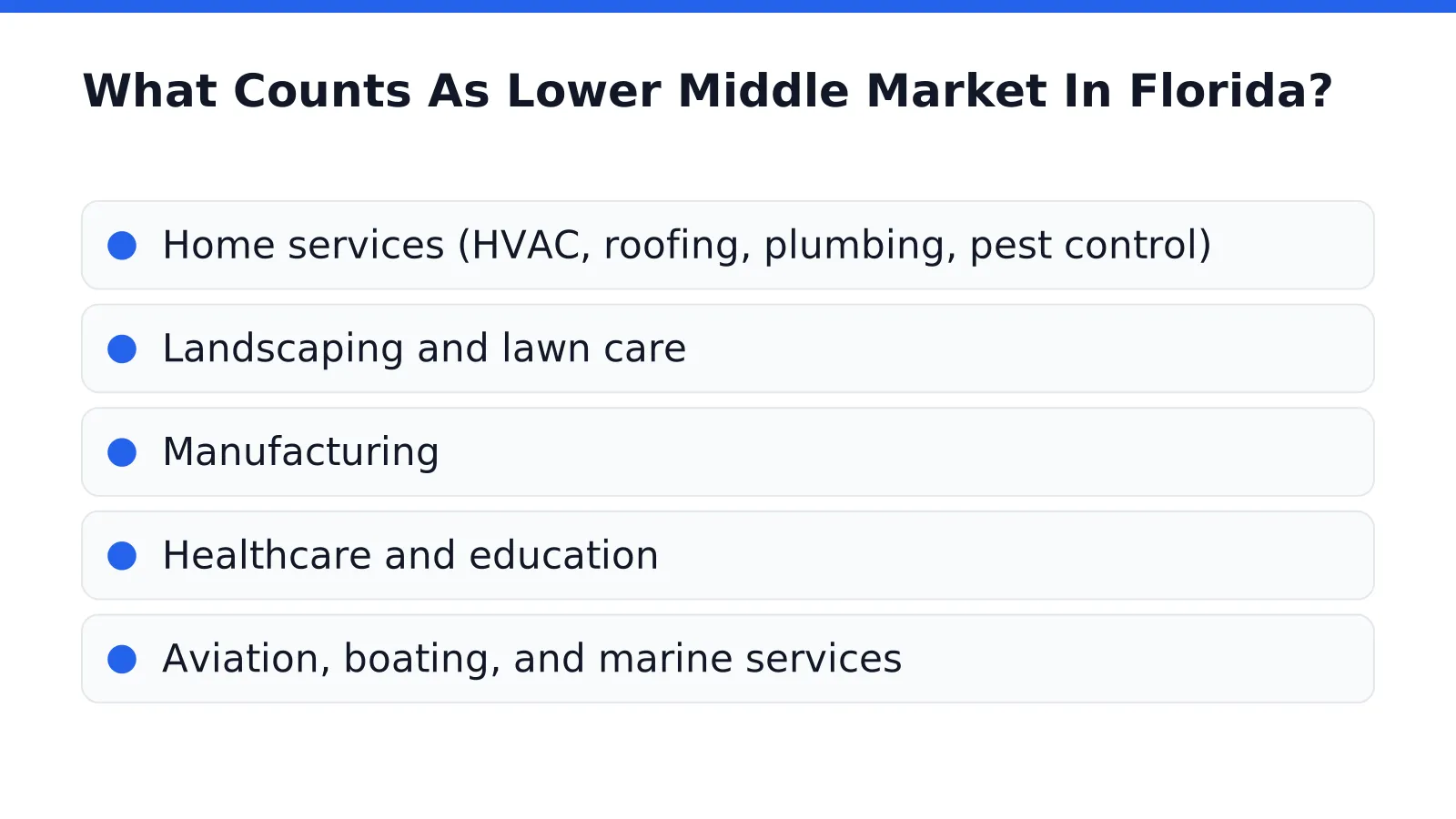
Lower middle market deal valuation work in Florida spans several industries:
- Home services (HVAC, roofing, plumbing, pest control)
- Landscaping and lawn care
- Manufacturing
- Healthcare and education
- Aviation, boating, and marine services
CII Advisors serves owners across both Florida and Georgia, giving it a regional vantage point on how these deals move. Operating for over four decades has also given the firm a long-term view of Florida’s market cycles, insight that matters when timing an exit in a business tier this specific.

How Do EBITDA Multiples Drive Value?
A multiple applied to earnings, usually EBITDA, sets the baseline price for most privately held companies on the market today. That multiple moves up or down based on how buyers read the company’s growth prospects and risk profile. For a Florida landscaping or home services company weighing a sale within the next few years, understanding this mechanic separates owners who negotiate from strength from those who simply accept an opening offer.
Capital market conditions and industry trends shape multiples at the margins. A strong florida ma advisory ebitda multiples environment for HVAC or roofing companies, for example, might elevator buyer appetite across an entire sector. But the biggest swings in value rarely come from outside forces. Company-specific factors, the ones an owner actually controls, tend to drive the largest differences between a mediocre offer and a strong one.
What Factors Inside the Business Move the Multiple Most?
Owners who want a stronger multiple should focus on what examiners inside the deal process actually scrutinize. These factors typically include:
- Consistency of earnings over multiple years
- Diversification of the customer base
- Strength and depth of the management team
- Documented, repeatable operating processes
- Reduced dependence on the owner personally
Each of these reduces perceived risk, and lower risk translates directly into a higher multiple.
Why Does Preparation Matter Before Going to Market?
Preparation determines whether a company captures full value or leaves money behind. Buyers pay a premium for businesses that look organized and lower-risk well before any letter of intent arrives.
Lower middle market business valuation florida work benefits from this kind of advance diagnostic. CII Advisors offers business valuation services designed to show Florida owners exactly where their company stands relative to market expectations. The firm’s active membership in M&A Source, IBBA, and Axial informs how those EBITDA-based methods get applied, giving owners a credentialed read on value well ahead of a sale decision.

Which Florida Industries Command Premium Multiples?
Home services, equipment rental, and consumer-facing manufacturing currently draw the strongest buyer interest among Florida’s lower middle market businesses. Buyers pay up for scale, consolidation potential, and recurring revenue, three traits these sectors share across the state. Owners weighing business exit planning valuation florida strategies should pay close attention to where their industry sits on this spectrum.
Landscaping and lawn care stand out as a genuine Florida success story. The state holds 9 spots on the 2024 national ranking of the largest lawn care. Landscaping businesses by revenue, a concentration few other states can match. That density signals deep buyer familiarity with the sector. A steady pipeline of acquirers looking for their next platform or add-on.
Why are private equity firms targeting Florida landscaping companies?
Consolidation is already underway. Fort Myers-based Juniper Landscaping recently expanded through acquisitions of established landscape businesses in South Florida. On the Emerald Coast, a clear sign that buyers see fragmented, regional operators as ripe for roll-up strategies. For owners in this space, that activity often translates into stronger florida ma advisory ebitda multiples than less consolidated industries.
Equipment rental tells a similar story. Synergy Equipment operates more than 7,500 compact and heavy equipment rental units across 23 branches spanning Florida, Georgia. Alabama, illustrating how scale and geographic reach attract buyer attention in this sector.
Consumer brands matter too. Krispy Kreme maintains 33 locations across 24 Florida cities, a retail footprint that highlights why manufacturing and consumer-facing businesses with strong brand recognition continue to draw investment statewide.
What Value Drivers Can Owners Control?
Owners control more of their company’s value than most assume. Stable earnings, a diversified customer base, and a strong management bench often command premium multiples in a sale, according to analysis of middle-market valuation trends. These three factors sit largely within an owner’s reach, long before a Florida business ever reaches the market.
Contrast that with businesses carrying hidden risk. A landscaping or HVAC company in Tampa or Jacksonville with one customer representing a third of revenue faces real exposure. Compliance gaps and operational weak spots create similar problems. Buyers respond to these red flags with valuation discounts or deal terms that shift risk back onto the seller, often through earnout structures rather than cash at closing, making earnout negotiation strategies Florida owners understand essential before entering talks.
What makes a business a “top performer” in its industry?
Top performers consistently command top dollar from buyers, a principle that holds across industries and company sizes. Defining a top performer, though, takes more than strong revenue. Buyers look at earnings consistency, management depth, and how well the business runs without the owner physically present.
Which value drivers matter most before a sale?
Owners preparing for business exit planning valuation in Florida should prioritize the drivers most visible to buyers during due diligence:
- Earnings stability: Consistent, predictable cash flow over multiple years
- Customer diversification: No single client representing outsized revenue share
- Management depth: A team capable of running operations without the owner
- Compliance and documentation: Clean records that withstand buyer scrutiny
Building management depth rarely happens overnight. CII Advisors offers succession planning services designed to help owners strengthen leadership benches well before a sale, closing the exact gap that often triggers conservative deal structures. For a Fort Myers manufacturer or an Orlando home services company eyeing an exit in the next one to three years, that groundwork often separates a premium multiple from a discounted one.
How Do Florida Buyers Structure Deals?
Florida lower middle market buyers rarely fit one mold. Private equity firms, strategic acquirers, investor groups, family offices, and entrepreneurs hunting for established companies with clear upside all compete for the same pool of businesses. Each buyer type brings its own priorities, timeline, and appetite for risk, which shapes how a deal gets built from the first offer to the closing table.
This diversity matters because florida ma deal structures vary widely depending on who sits across the table. A family office may favor a slower, relationship-driven process. A private equity group often moves faster but demands more rigorous financial documentation.
Why does buyer type affect deal terms?
Buyer type affects deal terms because each category of buyer evaluates risk differently. Strategic acquirers often pay a premium for synergy and market position, while financ
FAQ
What is the primary method for valuing a lower middle market business in Florida?
Valuation centers on applying a multiple to adjusted EBITDA, factoring in growth potential, risk, and industry trends. Company-specific factors like customer concentration and recurring revenue drive value beyond market conditions alone.
What qualifies as a lower middle market business in Florida?
Lower middle market businesses are companies with annual sales between $5 million and $50 million. CII Advisors, based in Orlando, specializes in guiding owners of these companies through valuation and sale.
Why should a Florida business owner get a formal valuation before selling?
Skipping valuation risks pricing too high and scaring off buyers, or too low and losing years of built equity. CII Advisors uses competitive, auction-style buyer processes to establish accurate, defensible valuations before a sale.