

EBITDA, or earnings before interest, taxes, depreciation, and amortization, measures a company’s core operating profitability by adding interest, taxes, depreciation, and amortization back to net income. Buyers use this figure to value lower middle market companies. CII Advisors runs competitive, auction-style buyer processes to help owners secure stronger sale prices.
Key Takeaways
- EBITDA measures operating profitability by excluding interest, taxes, depreciation, and amortization expenses.
- Calculating EBITDA requires adding back four specific costs to net income or operating income.
- Lower middle market companies with $5-$50 million in sales benefit from understanding EBITDA valuations.
- EBITDA excludes capital costs, which can overstate a company’s actual profitability and financial health.
What Does EBITDA Really Mean?
EBITDA measures a company’s operating profitability by stripping away interest, taxes, depreciation, and amortization costs. Strip away those four items, and what remains shows how the core business performs on its own, separate from financing decisions or accounting choices. For a founder preparing to sell, that distinction matters more than it might first appear.
The acronym itself spells out the formula: earnings before interest, taxes, depreciation, and amortization. Each word represents a cost that gets added back to net income to reveal operating performance. Buyers lean on this figure because it lets them compare businesses with different debt loads, tax situations, or equipment ages on a level playing field.
Why does EBITDA matter when selling a business?
Buyers and advisors use this metric as the foundation for most valuation multiples in a sale. A company’s purchase price often gets expressed as a multiple of this earnings figure. A stronger number translates directly into a stronger offer.
What’s the difference between EBITDA and net income?
Net income already accounts for interest payments, tax obligations, and non-cash charges like depreciation. Backing those items out produces a cleaner view of operating cash generation, one that doesn’t shift based on how a business finances its equipment or structures its debt.
CII Advisors, an M&A advisory firm, helps some of the largest landscaping companies and other lower middle market business owners understand this metric long before a deal reaches the negotiating table. The firm works with owners of lower middle market companies, the exact segment where this calculation drives nearly every valuation conversation.
How Do You Calculate EBITDA?
Calculating EBITDA starts with net income or operating income, then adds back four specific expense categories: interest, taxes, depreciation, and amortization. Business owners who skip this step often misjudge what their company actually earns from operations. The formula strips away financing decisions, tax strategy, and accounting adjustments that have nothing to do with how well the business runs day to day.
Picture net income as the number after every bill gets paid, including the bank and the IRS. Add the interest paid on loans back in. Add back taxes owed. Then restore depreciation and amortization, the non-cash charges that spread the cost of equipment and intangible assets over time. What remains is a clearer picture of operating performance, separate from how the company finances itself or structures its assets.
What Numbers Go Into the EBITDA Formula?
The calculation only requires four line items pulled from the income statement:
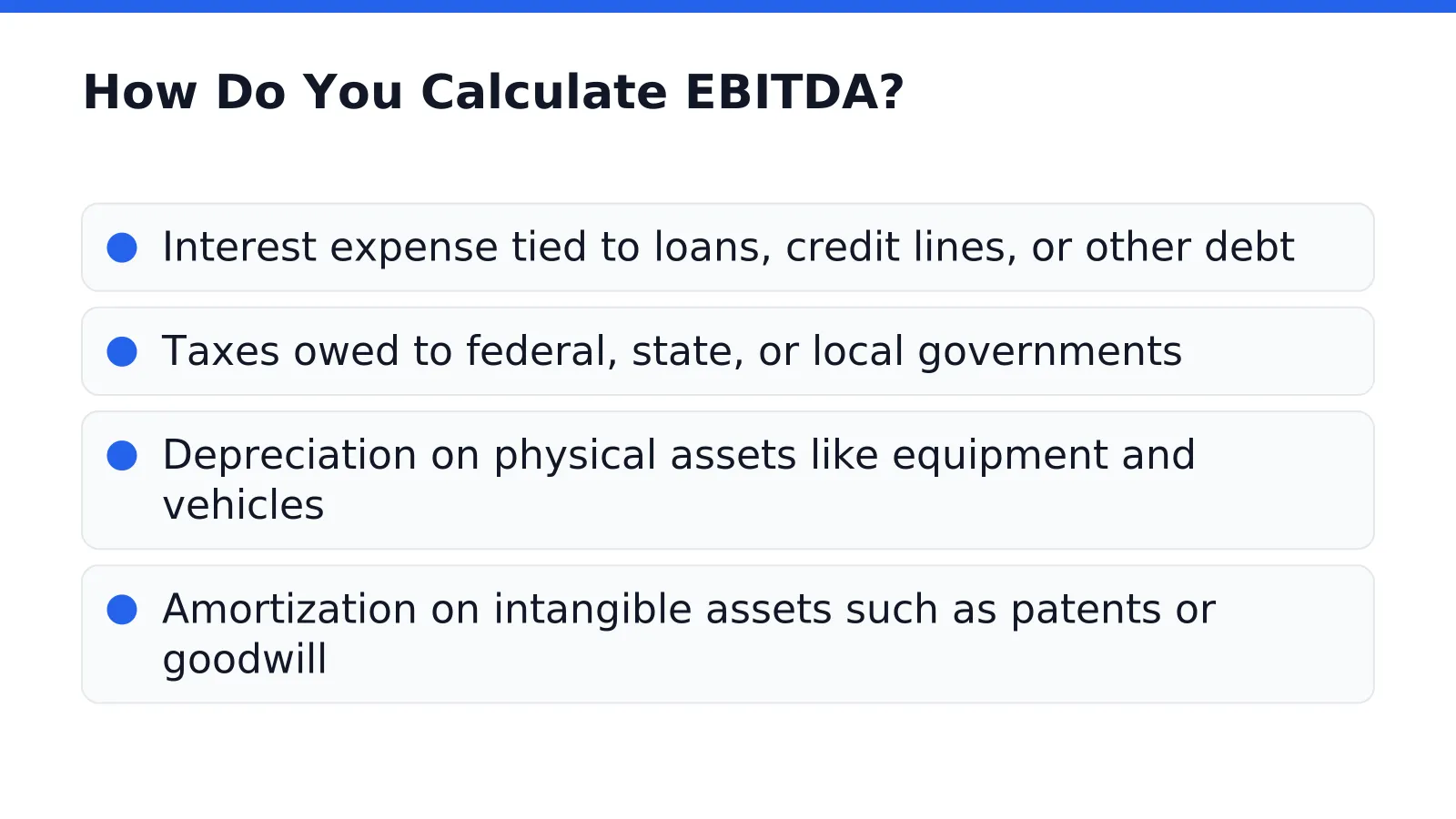
- Interest expense tied to loans, credit lines, or other debt
- Taxes owed to federal, state, or local governments
- Depreciation on physical assets like equipment and vehicles
- Amortization on intangible assets such as patents or goodwill
Adding these four categories back to net income produces the EBITDA figure buyers. Lenders use to compare companies against one another.
Why Does the Calculation Matter Before a Sale?
Owners preparing to sell need an accurate EBITDA figure long before buyers start asking questions. CII Advisors offers business valuation services designed to help owners accurately calculate EBITDA, catching errors or missed add-backs that would otherwise shrink the final number. Since EBITDA often drives pricing conversations during mergers. Acquisitions, getting the math right protects the owner’s negotiating position from day one.

Why Do Buyers Focus On EBITDA?
Buyers focus on EBITDA because it strips out financing and accounting noise to reveal a clearer picture of cash flow. Owners who ignore this metric risk undervaluing their companies or misreading a buyer’s offer entirely. A business can look highly profitable on paper and still fail to earn a strong valuation if its EBITDA tells a different story.
EBITDA stands for earnings before interest, taxes, depreciation, and amortization. Removing those four categories lets a buyer compare operating performance across companies, even when debt loads, tax situations, and asset depreciation schedules differ wildly. It is not recognized under generally accepted accounting principles. It remains one of the most widely used benchmarks for comparing financial performance across businesses of similar size and industry.
What Does EBITDA Actually Reveal About a Business?
EBITDA reveals how much cash a company’s core operations generate before outside factors distort the picture. Interest expense depends on how much debt an owner carries, not on operational health. Taxes vary by entity structure and location. Depreciation and amortization are non-cash accounting entries. Stripping all four away shows buyers the engine underneath, not the paperwork around it.
How Should Owners Prepare for an EBITDA-Focused Buyer?
Owners should expect buyers to scrutinize every line item that feeds EBITDA. Clean, well-documented financials matter long before a sale begins. The advisors at CII Advisors stay active members of M&A Source, IBBA, and Axial, organizations that keep them close to current buyer behavior and valuation trends. That involvement shapes how CII Advisors prepares Florida and Georgia business owners for the questions buyers ask most:
- Which add-backs are legitimate and which will buyers challenge?
- How consistent is EBITDA across the trailing three years?
- What one-time expenses distort the current year’s numbers?
Buyers across Florida and Georgia weigh these questions before applying any multiple to a business.

What Are EBITDA’s Key Limitations?
EBITDA overstates a company’s true financial health in one specific way: it leaves out capital costs entirely. A business can show strong operating earnings while quietly underfunding the equipment, vehicles, or facilities it depends on to keep running. That gap matters enormously to a buyer evaluating a business for purchase.
Owners preparing for a sale often lean on EBITDA because it strips away financing decisions, tax strategy, and non-cash accounting entries. That simplicity is useful for comparing businesses, but it hides real spending. A landscaping company with aging mowers and trucks might post the same EBITDA as a competitor with newer equipment. The two businesses face very different near-term expenses.
Why does EBITDA need to be reconciled to net income?
Regulators take this limitation seriously. Public companies face a requirement to reconcile EBITDA back to net income, a rule that exists precisely because EBITDA is not a complete measure of profit on its own. That reconciliation forces a clearer picture of where earnings actually land after interest, taxes, depreciation, and amortization are counted.
For a private business owner, the lesson translates directly: a buyer’s advisors will perform their own version of that reconciliation during due diligence.
What should business owners do about these limitations before selling?
Owners should expect adjustments, not resist them. Common areas that get revised include:
- Deferred equipment replacement or maintenance
- Owner compensation and personal expenses run through the business
- One-time or non-recurring revenue events
CII Advisors has spent over three decades working through these adjustments with business owners across the Southeast. That experience shapes how CII Advisors’ succession planning services project a company’s future value, accounting for what raw EBITDA leaves out before a sale ever reaches the negotiating table.
How Does EBITDA Shape Your Sale Price?
EBITDA sets the baseline number buyers use to calculate what a business is worth. Earnings before interest, taxes, depreciation, and amortization strips away debt costs, tax obligations, and asset-related expenses to reveal how the operating business actually performs. Buyers apply a multiple to that number, so every dollar added to EBITDA often translates into several dollars of sale price.
Owners who treat EBITDA as an afterthought risk leaving real money on the table. A buyer looking only at bottom-line net income might see a company weighed down by debt payments or heavy depreciation. Assume it’s worth less than it truly is. EBITDA corrects that distortion by focusing on operating performance alone.
CII Advisors, based in Orlando, Florida, builds its valuation work around this exact lens. Business valuation services from the firm start by identifying true operating profitability, then adjusting for the one-time or owner-specific costs that often cloud a company’s financial picture.
What role does EBITDA play in buyer negotiations?
Buyers negotiate from a multiple-of-EBITDA framework almost universally. A clear, well-supported EBITDA figure gives business owners stronger footing at the table. It limits how much room a buyer has to argue the number down.
Why does EBITDA matter more than net income when selling?
Net income reflects financing decisions and accounting choices that have nothing to do with how well the business operates day to day. EBITDA removes that noise. Two companies with identical operations but different debt loads can show very different net income figures, yet nearly identical EBITDA.
Translating that number into a negotiable offer takes experience. CII Advisors specializes in helping lower middle market business owners sell their companies. Execute successful business exits, converting raw EBITDA figures into pricing conversations buyers take seriously, framing the number in terms that hold up under scrutiny once offers start arriving.
How Does EBITDA Differ From EBIT?
EBITDA and EBIT both strip out financing and tax effects, but EBITDA goes one step further by adding back depreciation and amortization too. EBIT, or earnings before interest and taxes, stops at operating income. EBITDA measures operating performance by excluding financing costs, taxes, and certain non-cash expenses like depreciation and amortization. That extra layer matters for owners comparing two companies with very different equipment or asset bases.
Think of EBIT as a snapshot after wear and tear gets counted. EBITDA removes that wear and tear from the picture entirely. The calculation works by subtracting operating costs, wages and raw materials among them, from total revenue, without touching asset depreciation or the cost of borrowing. The result shows cash-generating ability before the accounting choices around assets enter the equation.
Why Does This Distinction Matter When Selling a Business?
Buyers use both figures, but for different purposes. EBIT reflects how asset-heavy a business truly is, since depreciation stays in the calculation. EBITDA, by contrast, offers a cleaner view of operating cash flow. Many buyers use as the starting point for valuation multiples.
Owners weighing a sale within the next few years benefit from understanding both numbers, not just one. CII Advisors, an M&A advisory firm, walks owners through these distinctions plainly before a deal ever reaches a buyer’s desk. Its business valuation services lay EBIT and EBITDA side by side. Owners see exactly how each figure shapes a buyer’s offer and where adjustments might change the final number.
How Can You Improve EBITDA Pre-Sale?
Trimming unnecessary spending, tightening operations, and documenting a clean financial history raise EBITDA before a sale closes. Owners who wait until a deal is in motion lose months they could have spent building value. The earlier the cleanup starts, the more credible the numbers look to a buyer.
Because EBITDA strips out capital costs like interest, taxes, depreciation, and amortization, it can make a business look more profitable than its cash flow actually supports. That gap cuts both ways. Owners who address bloated or inefficient spending ahead of a sale often see the metric climb. Fewer non-operating costs are dragging down the operating picture buyers care about most.
What steps actually move the needle on EBITDA?
Preparation matters more than last-minute adjustments. A few areas consistently make a difference:
- Removing personal or discretionary
FAQ
What is EBITDA?
EBITDA stands for earnings before interest, taxes, depreciation, and amortization. It measures core operating profitability by adding those four costs back to net income, separate from financing decisions or accounting choices.
Why do buyers use EBITDA in a business sale?
Buyers use EBITDA as the foundation for valuation multiples, expressing a company’s purchase price as a multiple of this earnings figure. A stronger EBITDA number translates directly into a stronger offer.
How does EBITDA differ from net income?
Net income already accounts for interest, taxes, and non-cash charges like depreciation. Removing those items from net income produces a cleaner view of operating cash generation that doesn’t shift with financing or debt structure.